Anani Kaike.
February 3, 2019
“El cuatro vivir en mi. Y yo vivire en el cuatro.”
“The cuatro lives in me. And I live in the cuatro.” El maestro de Cuatro
Maso Rivera.
The Aguinaldos and jibaro music of Borinquen have always been very close to my heart. I always heard them and loved them. Their rhythms and sounds took me home (to Borinquen). Even though I have never been to Borinquen this music is a way to connect, to hear the sounds of my homeland. This music is the music that sings of the conditions that my family did experience in Borinquen. My father always told me that my grandfather loved (and still reminds me of my grandfather’s love of), the music of Ramito, Luisito, Moralito, Chuito El de Bayamon and the other Boricua jibaro singers. My father always instilled a love of the Musica Jibaro. Every year on my grandfather’s birthday we play the Jibaro Music he loved, for him. I think about the Grandfather, who I never met but I have always known, every time I listen to Aguinaldos and Jibaro music. I am very grateful to my grandfather for teaching my father about this music so that now, my brother, Hatuey, and I, the next generation can appreciate it and keep it alive for the generation after us.
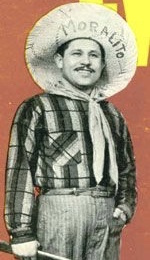
Los Hermanos Morales: Ramito, Moralito and Luisito were born in the Bairoa subsection, of Caguas, Borinquen. His father was Juan Morales Diaz and his mother was Leonarda Ramos, a sugarcane worker. The conditions of the childhood of Ramito, Moralito and Luisito was not uncommon in Puerto Rico in the 1920’s and 1930’s. Ramito went to school until the 4th grade, but had to leave school to help his parents who were raising 13 children, only 6 being theirs, 7 being “adopted”. Ramito is quoted saying in an interview in answer to the question, “Where did you study?” he said “I studied at the big university of life”. And when asked where he was born he answered, “I was born in what I would say is the capital of the world, in the Bairoa neighborhood of Caguas”. His mother worked in the sugar cane fields, the work was harsh, with 12 hour days in the blazing unshaded fields, (heat stroke was common) and the pay was terrible typically around .45¢-.70¢ a day. Young Ramito and his other brothers would work in the fields, singing his mother her favorite songs, bringing water to her and the other workers. Most likely the case with Ramito’s family is that the other children his parents were raising, were with them becuase their parents just could not care for them and gave them to Ramito’s family, who may have been a little bit more able to care for them. Still Ramito’s family lived in complete poverty. Of the 13 brothers only 6 survived to adulthood. Before he reached fame as a singer, Ramito, worked as a jailer, fireman and cane-cutter.
This was not uncommon at all in Borinquen at this time, in fact it was extremely common. The story of the Morales Brothers is very similar to that of the family of journalist and former member of “Young Lords Party”, Juan Gonzalez. After Juan’s grandfather died his grandmother with her 6 remaining children, (5 of her 11 children had died) were thrown into complete poverty and she was unable to care for them. She then gave her remaining children away to other families, she was only able to care for one daughter, the youngest, Juan’s aunt Pura, and would hide her under the hospital sink at her job. Juan’s father, Pepe, faced abuse while in the care of a teacher. This story was very common in Puerto Rico in the 1920’s, 30’s and 40’s.
“For the multitudes life became unbearable. Wages for cane cutters, which had been .63 cents for a twelve-hour day in 1917, were down to .50 cents by 1932. ‘Slow and rapid starvation was found everywhere. If one drove a car over the country roads, one was delayed again and again by sorrowing funeral processions carrying the caskets of dead infants’”- excerpt from Juan Gonzalez’s book “Harvest of Empire: A History of Latinos in America”(link)”.
The pay drop for sugar cane workers would coincide with the childhood of Los Hermanos Morales. The rates of starvation and death in children was extremely high. Some mothers even chose to kill themselves and their children instead of live in the poverty that was all around them. This was a repeat of history, many Taino women did this under Spanish rule. Take a moment to imagine what the conditions were for this even to be an option.
Ramito and his brothers began to sing in neighborhood competitions and began winning, due to their clear vocal style. Ramito was given the title, (Ramito), when was 17 and a recording company asked him what he would like to have as his official title. He chose Ramito to honor his mother’s last name-Ramos. They soon were singing and performing around Caguas and nearby areas for extra money to help their parents. In the ensuing years they became some of the most famous Jibaro singers in Puerto Rico. Moralito was known to write a song or more than one song per week. He was a master of improvising lyrics to songs, if he ever forgot the lyrics to a song he would simply improvise. Moralito’s music was very much inspired by his childhood experiences and his love for Borinquen. Both Ramito and Moralito would perform with a machete and traditional “Jibaro hat”, the way that sugarcane workers would dress in their work. This clearly shows that they never disconnected from the gente, their gente, our gente.
I It is very sad to see that this music is becoming less and less common. This music must be kept alive for the future generations. In an interview with Luisito Morales in 2006 he reminisces about the times when Jibaro Music could be heard everywhere. “The Jibaro music was listened to more than now (by) a thousand times. Now you hear (it) , but not as much as before. Before the music was heard in hotels and resturants.” Luisito also speaks of the influence of their grandmother, mother and grandfather. Leonarda Ramos (their mother) would sing popular songs and make up her own songs, she inherited this love for music from her mother. Luisito remembers that his mother, Leonarda, was always singing. Their paternal grandfather would also sing and was known to have a great singing voice. Luisito ends the interview by saying “This is the music of our ancestors. We need to carry it always.”
Moralito, “El Jibaro de Tierra Adentro”, (the second oldest) died on July 21, 1988 at the age of 64 in a Rio Piedras hospital due to complications after suffering a car accident that resulted in the amputation of both legs. Ramito,“El Cantor del La Montana”,(the oldest), sadly killed himself on February 23, 1989 after he found out that his cancer was coming back worse than before. He is buried in a small village cemetery in Salinas, Puerto Rico. He had 8 daughters and 2 sons, many of them inheriting his talent. He was 71. Luisito, “El Montanero de Bairoa”, (the youngest), died on July 15, 2009 at the age of 81.

There is also a traditional plena by Ramito that is worth special note: “ Que bonita bandera”(link) was a song Ramito wrote and sang in the 1950’s to show support for the Puerto Rican fight for independence. In the years before the song, singing Puerto Rican Nationalist song or owning a Puerto Rican flag was illegal and those who did could face jail time. In the song he mentions the names of Luis Munoz Rivera, Jose De Diego and Ramon Emeterio Betances all of whom fought for and were pro independence for Puerto Rico. The chorus was later used by the “Young Lords Party” as a sort of “anthem” for demonstrations and protests. Ramito sings:
“Representando la patria
después de Dios ella es la primera
que bonita bandera
es la bandera puertorriqueña.”“Y si hablan mal de mi Patria
es como si al fuego echaran candela
que bonita bandera
es la bandera puertorriqueña.”
“Representing my homeland
After god she is first
What a beautiful flag,
What a beautiful flag is the Puerto Rican flag”
“And if they speak badly of my homeland,
it is a fire we cast
What a beautiful flag
What a beautiful flag is the Puerto Rican flag.”

In the songs of the jibaro singers you will also find that they sing of the conditions such as in the song “El Dinero No Es La Vida”. In others songs like “A Desde mi Tumba” (“from my grave”) you will find knowledge of the Taino understanding that the dead can be spoken to. In “El Dinero No Es La Vida” (Money isn’t life), Ramito sings of the very, very rich and the extreme poverty in Borinquen.

We can also clearly see that things have not changed very much in respect to “La bonita bandera” when we see the woman who was harassed by a man in a park,(link),on her birthday for wearing a shirt with a Puerto Rican flag. All of this is a great reason for Boricuas to fly “La Bandera Puertorriquen”.

The Jibaro music of Puerto Rico is a way to go back and see and hear the condtions and the poverty in Borinquen at that time. The songs are not just songs but are a form a poetry from the point of view of the people. The songs of the jibaro also sang of their love for Borinquen, ‘La Isla del Encanto’. These Jibaro singers were not separate from the regular people of Borinquen, they were the regular people of Borinquen and they never separated themselves from them. It is important to keep our ancestors alive. It is sad to think that a majority Puerto Rican kids in the United States, my age would not be able to tell you who Ramito is, but ask them who Nicky Manaje is and they will know.
I lovingly dedicate this article to the memory and music of Ramito, Luisito, Moralito, Chuito El De Bayamon, El Indio Del Sabana Grande, Maso Rivera, Yomo Toro and Radamas Centeno (my grandfather who loved their music and our Beautiful Borinquen).
Note: Below are links from the Cuatro Project. They are instrumental in keeping this music alive. There is also a vast quantity of information on the project’s website in Spanish.
Special Thanks: To the Cuatro project for their vast quantity of information and for keeping this music alive.
 Voice of the Water Lily
Theirs is my kind of music; thank you for sharing the story. I had many records but, unfortunately, I lost everything but my house to Hurricane Ian. How/ where can I purchase the music of those great musicians?
LikeLike
I’m the great-granddaughter of Ramito. I love being able to see how my ancestors still have a place in everyone’s heart. Thank you for sharing!
LikeLike
It’s my honor. Your great grandfather gave us some very beautiful music!
LikeLike
Pingback: Feliz Cumpleanos a Ramito Morales and Miguelito Valdes – Voice of the Water Lily
Pingback: the 49th anniversary of ‘Nuestra Cosa latina’ ( our latin Thing), the day the fania all stars were born, August 26, 1971. – Voice of the Water Lily
What a lovely tribute to these jibaro musicians and to your grandfather.
By sharing all of their stories keeps their memory and their music alive!
I’ll be following you on your blog now!!
Thank you , Water Lily
LikeLike