Anani Kaike
February 26, 2019.
In Latin/Caribbean/Salsa music there are few women who broke the barriers that surrounded that genre. One of the women who definitely broke that barrier was Myrta Silva, La Gordita de Oro. Not long ago, my father was talking with me about music and mentioned Myrta. He had mentioned Myrta before and I had read about her in Celia Cruz’s autobiography, but did not know much about her, except that she was popular in Cuba and she had worked with La Sonora Mantancera. I was also aware that Myrta’s fans were in an uproar when she left La Sonora and Celia Cruz replaced her. So I followed up by immediately doing some of my own research and learned that her popularity was much greater than I had thought. On documentaries about Salsa and Latin Music, Myrta is not mentioned, like many influential people. It is essential to acknowledge people like Myrta who made way for the people who came after them. Without people like Myrta, who made the way, the next generation of women singers would not have the opportunity to be where they are (and only because the framework was laid, by people like Myrta, is their music even acceptable today). Myrta had a television show that was very popular among many Puerto Rican’s that lived in New York. Myrta’s show was the only show in Spanish at the time. My father vividly remembers her television show and it’s popularity with his mother, my grandmother, and many Boricua women of her generation.
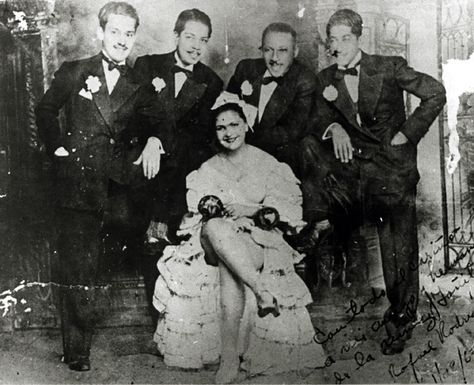
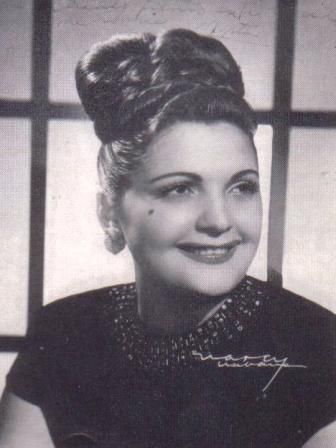 A young picture of Myrta in Cuba.
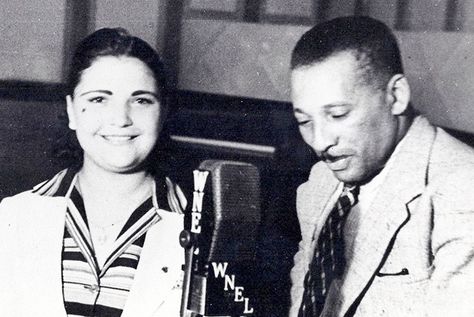
Myrta was born in Arecibo, Puerto Rico on September 11, 1927. Her father died when she was 6 years old and she was raised by her mother, who instilled in her a deep love for Puerto Rican and Jibaro music. Her mother was her main inspiration and she would often speak of her mother at performances. Myrta publicly performed for the first time at the age of 10. After a performance she was offered a contract with RCA Records and Radio Company she accepted and recorded some of her early hits, but didn’t stay with the company long. A woman, especially a Puerto Rican woman in her genre, being offered a recording contract was very unusual, at that time. In the late-1930’s Myrta met Rafael Hernandez and she joined his Cuarteto Victoria at the age of 16. After performing with Hernandez for some time she joined Pedro Flores’s Sexteto Flores. However it was not until she went to Cuba and joined La Sonora Mantancera did she reach huge popularity, not only in Puerto Rico and Cuba but in various South American Countries and American cities with Boricua communities, especially New York.
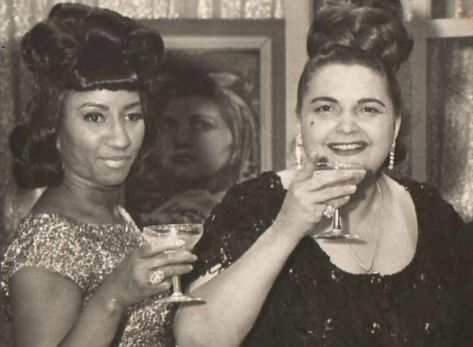
In 1949 Myrta became the lead singer of La Sonora Mantancera and was known as the Queen of Guaracha and was affectionately referred to as La Gordita de Oro, a name that stayed with her for the rest of her life. She was extremely popular in Cuba and in 1950 was deemed the “Most Popular Artist” in Cuba, male or female (a huge honor for someone that was not Cuban). She was also at the same time deemed ‘Best Selling Artist’ in Argentina. Argentina was not at all a center for Puerto Rican or Cuban music at that time (and still is not) so attaining this honor was a major achievment. At the same time she was also maintaining huge popularity in Borinquen and Boricua communities in America, (specifically in New York). She composed many songs in Cuba, including some of her biggest hits. Myrta also recorded with and performed with Daniel Santos who was also a member of La Sonora Mantancera . At the height of her fame in Cuba, Myrta decided to return to Puerto Rico.
Young Celia Cruz took her place in 1955 and remained there for 15 years. In fact when Celia first began singing, many of Myrta’s Cuban fans were very unhappy about the change (and even sent Celia letters of disapproval, some even telling her to leave La Sonora Mantancera). Celia was called ‘a no name singer’ in Cuba and Myrta’s fans were in an uproar demaning Myrta return as lead singer (at that time La Sonora Mantancera was the most popular band in Cuba). Only when Celia performed some of Myrta’s hits and with Myrta (performing the song “Cao Cao Mani Picao” was also a breakthrough for Celia) did she win over most of Myrta’s fans. Even though Celia, stayed with La Sonora longer and achieved wide popularity in her native Cuba, she never reached the popularity Myrta, a Boricua, who was younger than her by 2 years, performing in Cuba, had achieved.
Back home in Puerto Rico Myrta produced and stared in her own television show, “Una Hora Contigo”, in 1956, she then moved to New York. The show was extremely popular in both Borinquen and New York. It was the first Spanish language television show at that time. The show ran for many years. In New York she composed her biggest hits such as, Puerto Rico De Mi Alma, Que Sabes Tu and Tengo que Acostumbrarme. Myrta moved between New York and Borinquen until her early death in 1987.
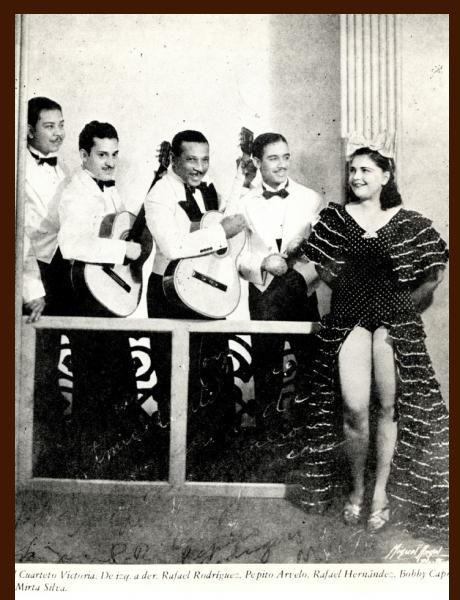 Myrta and Rafeal Hernandez’s ‘Cuarteto Victoria’. Left of Myrta is Bobby Capo (who also became popular in New york with his television show). Next to Capo is Rafeal Hernandez. In this picture Myrta is 16.
In the mid 1980’s Myrta began to show signs of Alzheimers Disease and they worsened quickly during the final years of her life. She accidentally spilled boiling water on herself in 1987 and suffered 3rd degree burns. She died on December 2, 1987 in Arecibo, Borinquen due to complications from several health conditions. She was 60 years old. She is buried in the Santa Maria Magladenna de Pazzis Cemetery in Old San Juan.
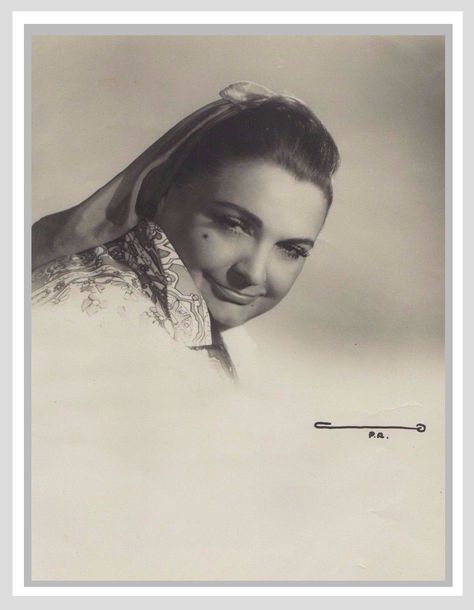
Myrta Silva was a very important figure in the world of Latin Music, however she is yet another talent that is not as acknowledged today as she should be. Myrta was remarkable because of her talent and because she was one of the few women who broke through the male dominated genre of Latin Music. Myrta’s memory needs to be kept alive for the future generations. The music, memory and struggle that Myrta had to go through as a Puerto Rican woman in the music industry cannot be forgotten. Myrta needs to be remembered and her music must always be cherished and passed onto the next generations. Myrta’s music is what keeps her alive. When her music is kept alive for the future generations, she continues to live on.

