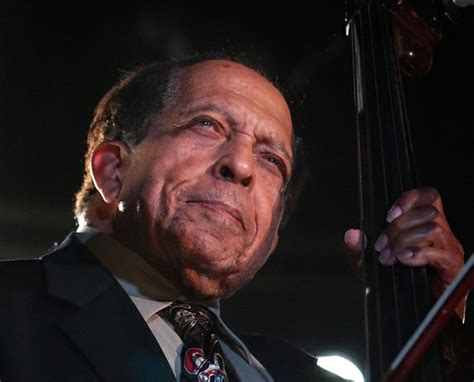
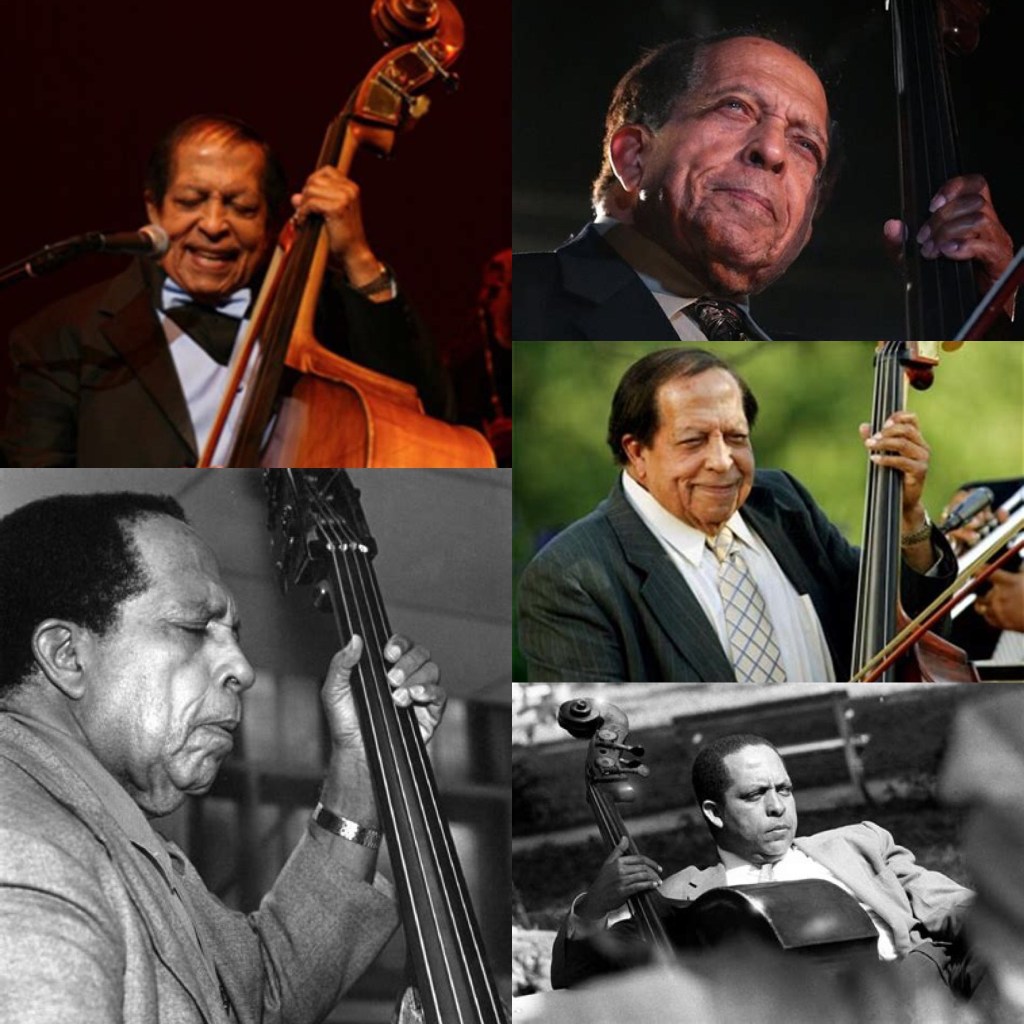
Israel López, better known as Cachao was the co-creator of mambo, bandleader, double bassist, composer, and arranger. One of his and his brother Orestes’ greatest innovations was mambo, livening up a classical Danzon, with afro-Cuban rhythm, as Cachao termed it “turning the ship 180˚”.
Israel López Valdés was born on September 14, 1918 in Belen, Old Habana. Interestingly, he was born in the same house that Jose Marti was born in. As a young boy, he was given the name Cachao by his grandfather, Aurelio López. His family had 40 musicians, most of them double bassists. Growing up in Havana and in this extraordinary family, filled Cachao with the rhythms that he would bring to the world and devote his life to.
Cachao played five instruments, his brother Orestes played twelve instruments and his sister Coralia played double bass and piano and were a bandleader, famous for writing the danzón ‘Isora Club’. She was also the first woman to direct a Danzón Orchestra.
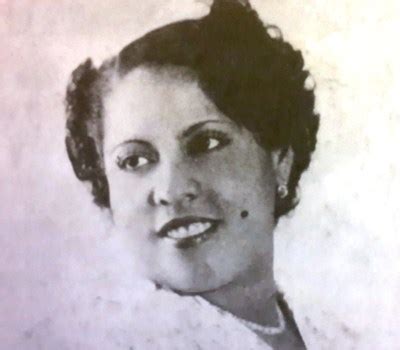
Juana Coralia Lopez 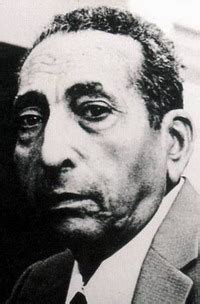
Orestes Lopez 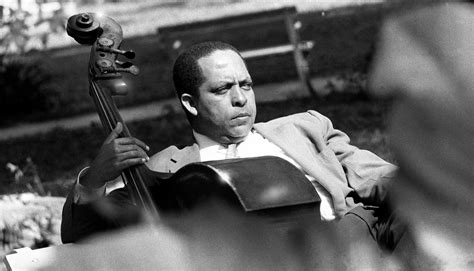
Cachao (Israel Lopez)
In 1926 he started his career, taught by his father, Pedro Lopez, and brother, Orestes, as a bongo player. However his relationship with his older brother, multi-instrumentalist, Orestes was a profound one. When asked of his brother he lovingly said. . .
“He was my idol, my inspiration. He’s the reason I’m a musician because I wanted to imitate him. He showed me how to compose, how to study double bass, and he put the love of music and innovation in my blood. To tell the truth I don’t think many brothers could have gotten along better.“
FACES OF SALSA, A SPOKEN HISTORY OF THE MUSIC, 2003, LEONARDO PADURA FUENTES
TRANSLATED BY STEPHEN J CLARK.
He joined a children’s Son Cubano band at the age of 8. The leader of the band was 14-year-old Roberto Faz. The next year he provided music for silent movies on his double bass. His first big break was with Arcano y sus Maravillas.
During his time with Arcaño, he and Orestes wrote 3,000 ‘danzons’, which Arcaño kept in a book, that was the repertoire of the band. Unfortunately one day someone stole the book of songs. Arcaño begged for the return of the songs, to no avail. Orestes and Cachao had to REWRITE ALL THE SONGS FROM MEMORY! He and Orestes each rewrote 28 danzones per week, until one day, Cachao sat down on a bench and didn’t get up. He woke up in the hospital. He and Orestes did manage to rewrite the whole repertoire! This just exemplifies the incredible genius he was and the determination he had!
Also during his time with Arcaño, Orestes and Cachao developed the sensational style that would be known as Mambo. The seminal song, titled ’Mambo’ was written in 1938 Though they probably didn’t know it then, this new style would captivate dancers till this day. The mambo arose as a variation of the popular Danzón with the rhythmic backbone of the conga playing the tumbao and Cachao working his magic on the double bass. The group’s timbalero, Ulpiano Diaz also added a cowbell to his timbales1. In the beginning, this was simply termed ’Danzon de Nuevo Ritmo’, however, the term Mambo came to be used. This innovation was especially seminal because, according to Oscar Hernandez, it exemplified the lower classes taking back the Danzón from the elite 2.
Surprisingly this ‘Danzon de Nuevo Ritmo’ did not take off immediately. According to Cachao, they couldn’t find work for 6 months because people just didn’t understand it. They had never heard anything like it before.
At first, they didn’t want to dance, but then they realized, ’you know this is good stuff. Well, they loosened up and the problem was over.
SALSA TALKS CHAPTER 17, PAGE 184–MARY KENT
Fortunately soon Mambo took over the airways. Arcaño Y Sus Maravillas’ popularity soared, their popularity could only be matched by ’El Ciego Maravilloso’, Arsenio Rodriguez.
In 1946 Cachao married Ester Buenaventura. They were married for 59 years until her passing in 2005. Cachao wrote a song dedicated to her called ’Buenaventura’.
In 1962, Cachao left Cuba. He moved to Madrid, then to New York, where he worked with a number of important bands including the Tito Rodriguez Orchestra among many others. Though Cachao never stopped recording, during the late ’70s until the late 80’s Cachao’s had to play at events such as weddings and quinceañeras just to support his family. Luckily he made a comeback after moving to Miami and his popularity began to rise again. He was honored at many tributes and he continued to perform and record. He won 3 Latin Grammys, one in 1994, the second In 2003, and another in 2005 as well as a posthumous in 2012 for his album ’The Last Mambo’.
A song worth special mention:
El Son No Ha Muerto: I love this song because it says, ”As you can see, the son is not dead, it is here in 1993”. The son is the backbone of Cuban music. Without son we would not have so much of the music we know and love. What Cachao is saying is that the son is not dead, symbolizing the root is not dead. The root, the foundation, of the music can never die, no matter how many trends come and go, the root will always be there alive and strong.
On March 22, 2008, Cachao joined the ancestors after an eight-decade musical legacy. The contributions Cachao made to Cuban music changed it forever. Cachao refused to be put in a box; he was an innovator; a genius; a true cultural icon. For all of this, we should be eternally grateful to this cultural ancestor.
- “Chapter 8.” Salsa!. the Rhythm of Latin Music, by Charley Gerard and Marty Sheller, White Cliffs Media Company, 1989.
- “Chapter 8.” Salsa!. the Rhythm of Latin Music, by Charley Gerard and Marty Sheller, White Cliffs Media Company, 1989.
- “Chapter 17.” Salsa Talks: A Musical Heritage Uncovered, by Mary Kent, Digital Domain, 2005.
 Voice of the Water Lily