Anani Kaike
December 21, 2018
“There is nothing to gain for those who seek salvation through weapons or money. If you want freedom, you must fight for it“ – Don Pedro Albuizu Campos
“When tyranny is law, revolution is order“ – Don Pedro Albuizu Campos
Early Degradation of the Island, Taino Genocide and Sugar:
Resistance and Terrible Conditions:
After being controlled by Spain for 400 years Puerto Rico became occupied by the United States in the year 1898. Thirty years prior to this, in 1868 1,000 people in the town of Lares rose to gain independence from Spain. Almost 30 years later in 1897 Spain gave Puerto Rico independence. But soon Puerto Rico became a colony yet again. On May 12, 1898 the US shelled and bombed San Juan. Landing by boat in Guanica, American soldiers marched into towns and raised American flags under the direction of general Nelson Appleton Miles. Literally overnight Puerto Rico was again a colony. Puerto Ricans were thought of as savages and senile people, unable and incapable of ruling themselves. Sen. Albert J. Beveridge is quoted saying “He(god) has made us adept in government so that we may administer government amongst savages and senile peoples”. This shows how the US viewed Puerto Ricans. In the following years Puerto Rico and Puerto Rican people were subjected to forced and unknown sterilization (the US goal was to have a 0% population growth by 1970), and the abrupt change from Spanish to English language in schools (leaving many children uneducated). Wages for sugar cane workers were down from 75 cents to 45 cents per twelve hour day. This drove many families to starvation. Many infants and young children died. All the while the sugar company ASR (American Sugar Refinery) that was occupying Puerto Rico, also known as Domino Sugar, was making huge profits. The first US appointed governor of Puerto Rico, Charles Herbert Allen became the president of Domino Sugar just a few years after his resignation. He controlled 98% of the land used to produce sugar. His only interest was the sugar company, his sugar company. He did not speak Spanish or know exactly where Puerto Rico was. The conditions were so terrible that some mothers even chose to kill their children and themselves. Here history repeated its self again, widespread suicides happened frequently under the brutal Spanish rule over the Taino.
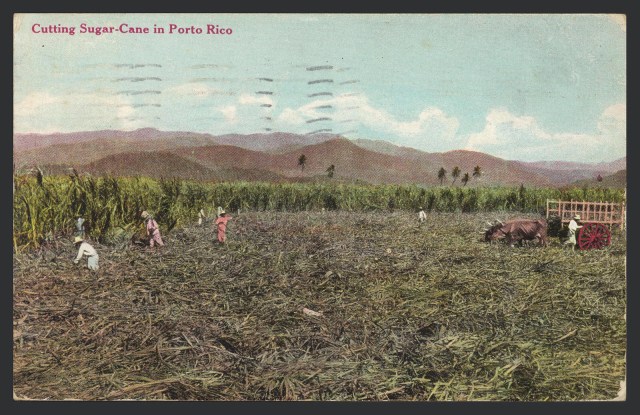 Sugar cane field 1939 Puerto rico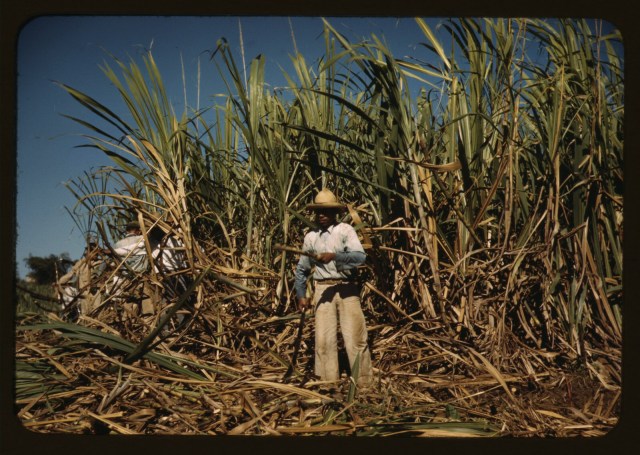
Machetero (sugar cane cutter) and sugar cane field. 1939. Guanica Ensenada, Puerto Rico
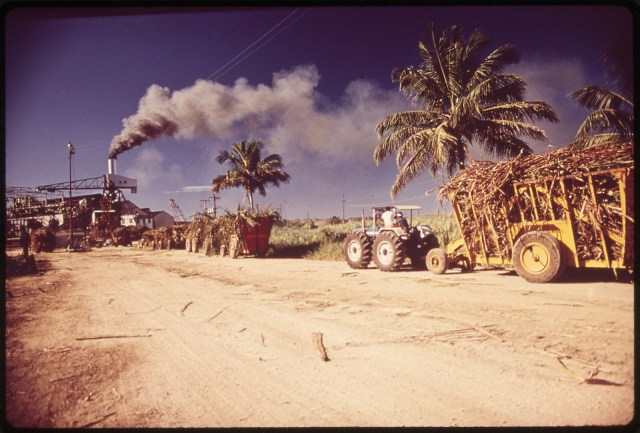 Sugar refinery 1973
Childhood, Education and Resistance against the US in Puerto Rico:
In 1930 he became the 2nd president of Puerto Rican Nationalist Party. Before the sugar Cane strike of 1933 the US didn’t pay much attention to the PNPR. However, in 1933, 85 strikes arouse within tobacco, needlework, and transportation industries. These strikes aroused concern in the man who would become police chief, the then colonel E. Francis Riggs (who was killed in 1935 after the Rio Piedras Massacre by two members of the PNPR). But soon his concern was turned to an all out hatred and desire to see all of the members of PNPR dead or imprisoned. He also had up to 100 FBI agents following and documenting Don Pedro everywhere he went. The cause was the island wide sugar cane workers strike organized by the PNPR during the Sugar Cane harvest. 9,200 workers went on strike and burned sugar cane. They wanted an 8 hour workday and higher wages. These demands were eventually met, this infuriated the US. Don Pedro was now a huge problem for the US, and they wanted him and all Puerto Rican nationalists dead or imprisoned. Following this, the Police chief Riggs decided to try and silence Don Pedro with another method. He invited him to a private meeting and offered him $150,000, a house and a governorship within 10 years if he would stop his political activism. Don Pedro politely said to the Police chief “my country is not for sale” and he then walked out. Don Pedro was arrested during police attempts to stop the protests and strikes around the island. Their attempts did not work, the strikes and protests got even bigger. Don Pedro was imprisoned for 11 years in Atlanta, GA. Many say the radiation or medical experiments started here, because when he returned to Puerto Rico he was suffering from mysterious health problems he had not had before he was imprisoned.
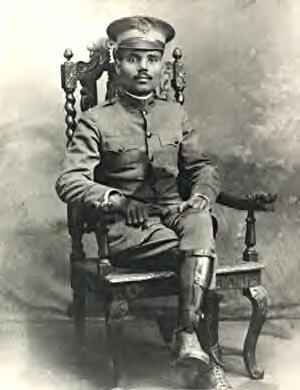
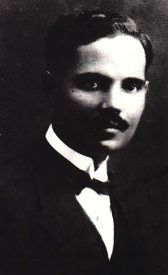
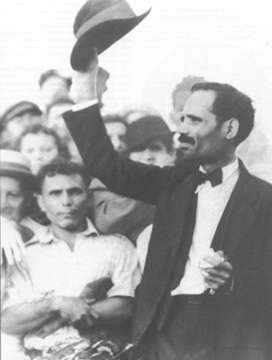

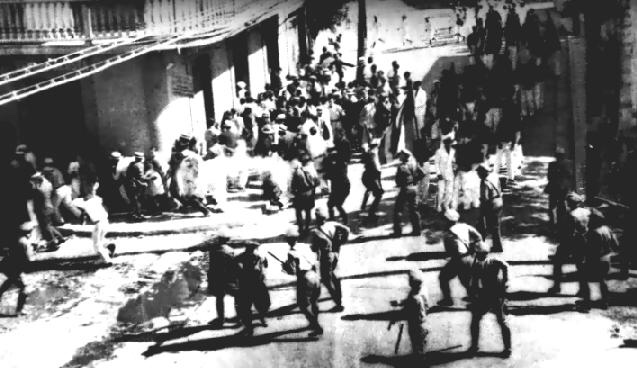
Panic in the midst of the ponce massacre.
In March 21, 1937 a peaceful march was organized in Ponce (which was the center of the PNPR) on Palm Sunday to protest the imprisonment of Don Pedro. Governor Winship had said he would give the protestors a permit, but at the last minute, he refused and claimed that the march was illegal. The marchers decided to do the protest despite the governor. Since it was palm Sunday many people were in the streets not only the marchers. Winship, who felt very threatened by the peaceful march, ordered the police be present. The police, which Winship had completely militarized, were equipped with machine guns, tear gas and riot gear. He also had the police cars painted bright red. As the protestors marched through the streets the police surrounded them and opened fire, even though many ordinary civilians were present celebrating Palm Sunday. 19 people were killed, 2 were police killed by their own department. The youngest person killed was a 7 year old girl who was shot in the back. The police, in total disregard for the dead, shot and kicked dead and dying people. The Ponce Massacre was a mass murder, orchestrated by governor Winship. Innocent people were simply trapped, and murdered.
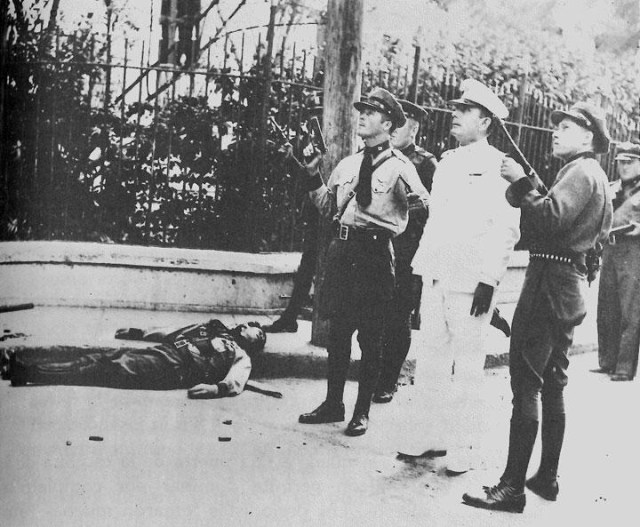 Police Chief Orbita (center in photo). The photo was used as part of a PR campaign, to cover up the Ponce Massacre. It shows Orbita pretending to look for the nonexistent snipers that supposedly started the violence.
 Voice of the Water Lily
Pingback: Don Pedro Albizu Campos; a genius revolutionary (revised version with podcast) – Voice of the Water Lily
Pingback: Don Pedro Albizu Campos, a genius freedom fighter. – Voice of the Water Lily
Pingback: Remembering the inolvidable y irrepetible Cheo Feliciano. – Voice of the Water Lily